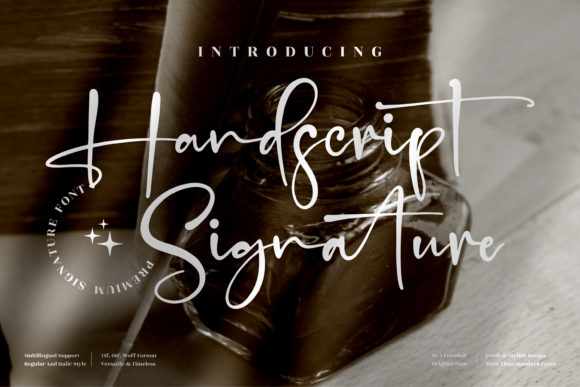
Handscript Signature Font: Elegant Script Handwritten Typeface
There’s that moment—mid-morning, coffee lukewarm, brand board open in Figma—when you scroll past ten script fonts and pause. Not because it’s flashy or loud, but because Handscript Signature lands with quiet confidence. I’d just started a visual refresh for a small-batch herbal tea brand: hand-poured blends, linen packaging, quiet storytelling. They needed warmth, authenticity, and a touch of refinement—not whimsy, not austerity. That’s when I dropped Handscript Signature into the logo draft. Instantly, the name felt like it belonged on a ceramic label, not a stock vector.
Handscript Signature for Logo Design and Brand Identity Systems
Handscript Signature is a Script Handwritten font built for presence—not decoration. Its letterforms have subtle contrast, soft entry/exit strokes, and just enough bounce to feel human without slipping into informality. I tested it across three logo variations: stacked, inline, and monogram-integrated. In every case, it held its own at 48pt on a business card mockup and scaled cleanly to 120pt on a shop sign preview. Crucially, it didn’t compete with the brand’s serif body typeface (I used a warm, low-contrast serif for copy)—instead, it anchored the system as the unmistakable voice. As a Fonts choice for identity work, Handscript Signature works best as a primary display font: logo lockup, wordmark, or hero headline. It’s not meant for paragraph text—but then, no thoughtful Script Handwritten font should be.
Handscript Signature on Packaging Labels and Product Mockups
Where Handscript Signature truly shined was on the tea tin label. Printed at ~14mm height on matte kraft paper, the characters retained their elegance without blurring or thinning out. The PUA encoding—mentioned in the product description—proved essential here: I accessed alternate lowercase “a” and “g” forms directly from the glyph panel, swapping in softer variants that better matched the brand’s gentle tone. No guesswork, no manual redrawing. That level of control matters when your client is printing 500 units and needs consistency across batches. As a Script Handwritten option for physical goods, Handscript Signature avoids the “too trendy” trap—it feels current but not dated, distinctive but not distracting. Just don’t use it below 10pt on labels; legibility softens fast in fine print.
Handscript Signature for Social Media Graphics and Web Headers
I dropped Handscript Signature into an Instagram carousel banner (1080×1350px) and a website hero section (desktop + mobile). At headline scale—42–64px—it read effortlessly against both light and muted backgrounds. The curves breathe, the spacing feels intentional, and the rhythm guides the eye naturally left to right. Because it’s PUA encoded, accessing swashes and ligatures was seamless in Figma and Adobe apps—no font manager gymnastics. That said, I wouldn’t use it for navigation menus or button text. This isn’t a utility Fonts family; it’s a statement Script Handwritten voice. Pair it with a clean, neutral sans serif (think a slightly rounded geometric or a humanist sans) for balance—never another script. Two scripts in one layout create visual noise, not harmony.
Handscript Signature for Wedding Invitations and Elegant Branding
A local stationer reached out mid-project asking if Handscript Signature would suit a limited-edition wedding suite she was designing for a couple who collect vintage botanical prints. Short answer: yes—especially for names, dates, and delicate accents. The font’s elegance isn’t stiff or ornate; it’s relaxed, confident, and quietly luxurious. On ivory cotton paper with blind deboss, the lowercase “y” and “f” swashes added movement without overwhelming. And because Handscript Signature is PUA encoded, she could easily insert custom flourishes between lines—something clients consistently request but few Script Handwritten fonts support intuitively. That flexibility makes it a strong contender among premium Fonts for high-touch, detail-oriented projects where typography carries emotional weight.
When Handscript Signature Isn’t the Right Choice
Let’s be direct: Handscript Signature won’t solve every typographic need. It’s not ideal for long-form editorial design, app interfaces, data dashboards, or corporate annual reports. If your project demands strict accessibility compliance (e.g., WCAG AA for body text), this isn’t your workhorse Fonts solution. And while it performs well at medium-to-large sizes, avoid using it under 12pt in print or 16px on screen—especially in all-caps or tight tracking. Also, verify licensing before use: Handscript Signature is intended for commercial Script Handwritten applications, but always confirm whether your license covers web embedding, merchandise, or template resale. A quick check saves revisions later.
If you’re building something that needs to feel handmade but never amateurish—if your audience responds to sincerity over slickness—Handscript Signature earns its place in your working toolkit. It’s not magic, but it does what great Script Handwritten Fonts should: give voice to intention, not just aesthetics.